
Sex Offender Checks in Luce County
The official starting point is the Michigan Public Sex Offender Registry, or PSOR, managed by Michigan State Police. Choose Luce in the county field for a broad local list, or use a name, street, city, ZIP code, or radius when the question is narrower. Searchers can also use a registration number or MDOC number when one is already known. The portal offers statewide lists for all published, incarcerated, and non-compliant registrants.
The Luce County Sheriff performs the verified local law-enforcement role at 411 W. Harrie Street in Newberry. The sheriff can receive a report about suspected inaccurate or non-compliant registration information, but it does not replace the public PSOR search with a separate county list. Call 906-293-8431 when a Luce County concern requires agency review. Search results should be matched with care because similar names do not establish identity.
A Luce County search can also begin with a specific place rather than a person. Before entering an address, confirm the street number, ZIP code, and the radius that fits the safety question. A county filter is better when the goal is a broad view of published Luce County entries. A narrow radius is better when the concern centers on one known point. These controls sort published records; they do not predict conduct or confirm that a listed person is present.
Luce County Registry Contact
Registration has both state and local parts. Michigan State Police maintains the database and the statutory public interface, while the Luce County Sheriff is the verified local contact for registration matters in the county. A person reporting a concern should provide the relevant profile, observed address issue, and enough context for law enforcement to assess it. The public should not attempt its own compliance check at a residence.
The Michigan State Police registry program page explains the state program and contact route. Its official interface is shown below.
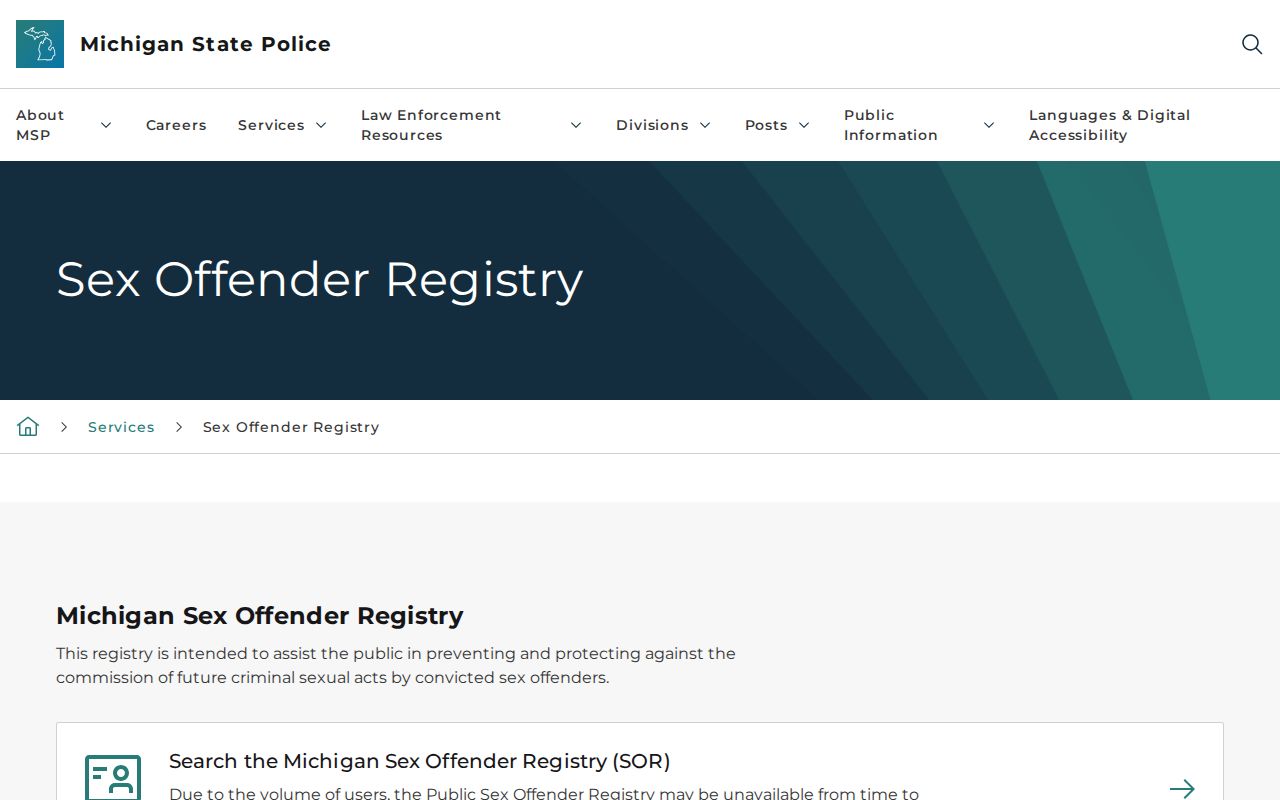
The state page helps separate program questions from Luce County reports that belong with the sheriff. MSP’s Sex Offender Registry Unit may also be reached at 517-241-1806.
How to Search the Michigan Public Sex Offender Registry (PSOR)
PSOR lets a reader move from a broad Luce County registry search to a specific public profile. Use only the facts supplied by the official result, and do not treat an empty search as proof that no law-enforcement registration record exists.
- Open PSOR and review the portal’s terms and public-use warning.
- Search by first and last name, an identifying number, or a Luce County geographic field.
- Narrow a geographic search with a street, ZIP code, county, and available radius when useful.
- Open the matching public profile and read its status, address, offense, vehicle, and registration details in context.
| Search field | Type | Use | Notes |
|---|---|---|---|
| First and last name | Text | Name search | Both are required in name mode; partial names are accepted. |
| Registration or MDOC number | Text | Identifier search | Either can serve as an alternate identifier. |
| Street, city, county, ZIP | Text/select | Place search | Select Luce for countywide published results. |
| Radius | Dropdown | Nearby search | Available distances are 0.25, 0.50, 1, 2, and 5 miles. |
| Published status lists | List | Statewide search | Options include published, incarcerated, and non-compliant offenders. |
Luce County Radius Searches
A countywide list and a radius search answer different questions. Selecting Luce County returns published registrants tied to the county filter. A radius search starts with an address and looks within one of five offered distances. The smallest quarter-mile setting is useful for a tight area, while the five-mile option reaches much farther in and around Newberry. Neither result is a live measure of where someone is at that moment.
Mapping may depend on the address data available for a profile. If an address cannot be mapped, read the written profile, try a broader location field, and contact the appropriate law-enforcement agency when there is a specific accuracy concern. Do not assume that a missing map pin removes a registration duty.
Note: A mapped address is registry data, not an invitation to visit, confront, photograph, or monitor the people who live there.
Inside a Registry Profile
A Luce County PSOR profile combines identifying, registration, status, and offense fields selected for public display under Michigan law. The data may include more than one address or alias, and status language should be read precisely.
| Name and aliases | Published legal name information and alternate names used to help distinguish records. |
|---|---|
| Photo and descriptors | A photograph, date of birth, and published physical details, including scars, marks, or tattoos. |
| Registration details | Registration number, status, and other public registration fields. |
| Location information | Registered address, campus information, and map control when available. |
| Offense information | Published conviction and offense details relevant to the registration entry. |
| Vehicle information | Vehicle details included among the statutorily published categories. |
PSOR status labels include Active, Incarcerated, Pending Out of State, Inactive Out of State, Absconder, Homeless, School Only, and Employment Only. “Absconder” means the person left the reported address and their whereabouts are unknown. It is not a general label for every non-compliant record.
Luce County Registry Limits
PSOR is the public subset of a broader law-enforcement registration system. A person’s absence from the Luce County public results does not prove that no record exists. Adjudicated juveniles are not publicly displayed. Other lawful reasons for absence can include nonresident or deceased status, an offense or date outside publication rules, judicial removal, completed registration duration, set-aside treatment, or Michigan’s Holmes Youthful Trainee Act.
Michigan law requires a public database, but it also defines what can be published. The Michigan Freedom of Information Act policy provides wider context for public access to government records.
The statutory access framework is why a public registry search and a law-enforcement registration file are related without being identical.
Michigan Registration Levels and Requirements
Michigan uses three tiers with different general durations and verification cycles. Exact classification, exceptions, and duties come from MCL 28.722 and MCL 28.725, so a public profile should not be used to give individualized legal advice.
| Tier | General duration | General verification |
|---|---|---|
| Tier I | 15 years | Once each year in the birth month |
| Tier II | 25 years | Twice yearly on the birth-month cycle |
| Tier III | Life | Quarterly on the statutory cycle |
Tier II cycles pair January with July, February with August, March with September, April with October, May with November, and June with December. Registrants must also report specified changes involving residence, name, work, education, lodging, vehicles, telephone, and travel within statutory deadlines. Michigan imposes a one-time $50 fee and annual $50 fees until a $550 cumulative ceiling, subject to current law.
Verification frequency describes the statutory reporting cycle, not how often a member of the public should check a Luce County address. Changes can arise between routine verification dates because separate duties apply to specified life events. For that reason, read the current Luce County profile status and its available details rather than trying to calculate compliance from the tier table alone. The sheriff or MSP registry unit can assess a concrete concern.
Luce County and National Searches
PSOR is the direct Michigan source for a Luce County registry search. When an inquiry crosses state lines, the U.S. Department of Justice’s National Sex Offender Public Website provides a federated search of participating jurisdictions. NSOPW is a useful second layer, not a replacement for reading Michigan’s record at its source.
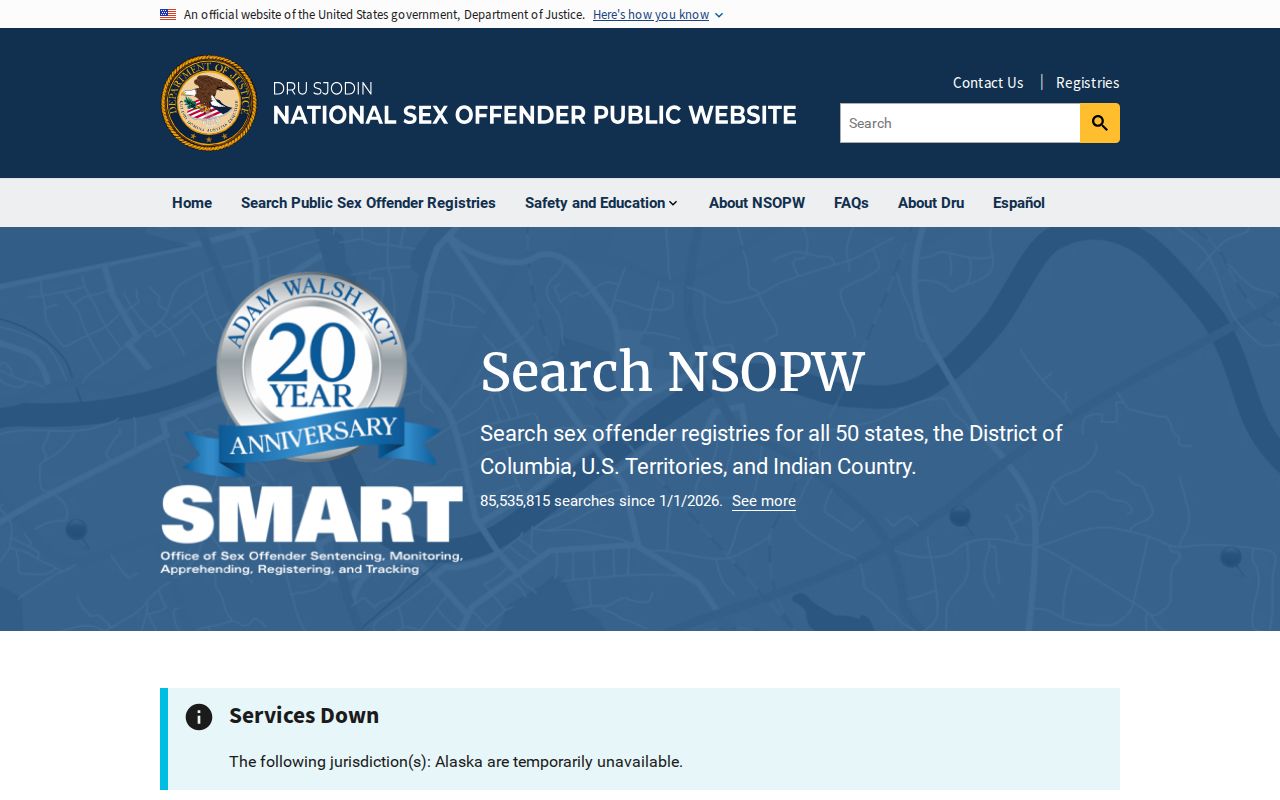
The national interface can point to records outside Michigan, while PSOR supplies the state-specific status and profile controls for Luce County.
Searchers should account for spelling changes, aliases, and the limits of each participating jurisdiction. A result from another state should be verified on that state’s official registry. A Luce County address alone does not establish that every linked event took place in Luce County.
Report a Luce County Registry Error
A public profile includes “Submit a Tip” as an action link. Use it when the concern is tied to a specific PSOR entry. A suspected inaccurate Luce County address or non-compliant status can also be reported to the Luce County Sheriff at 906-293-8431 or to the agency where the person is registered or actually located. Give facts, not conclusions, and let law enforcement determine what follow-up is warranted.
Registry information should not be mixed with other state record products. The MDOC probation and parole gateway describes supervision channels that answer a different question.
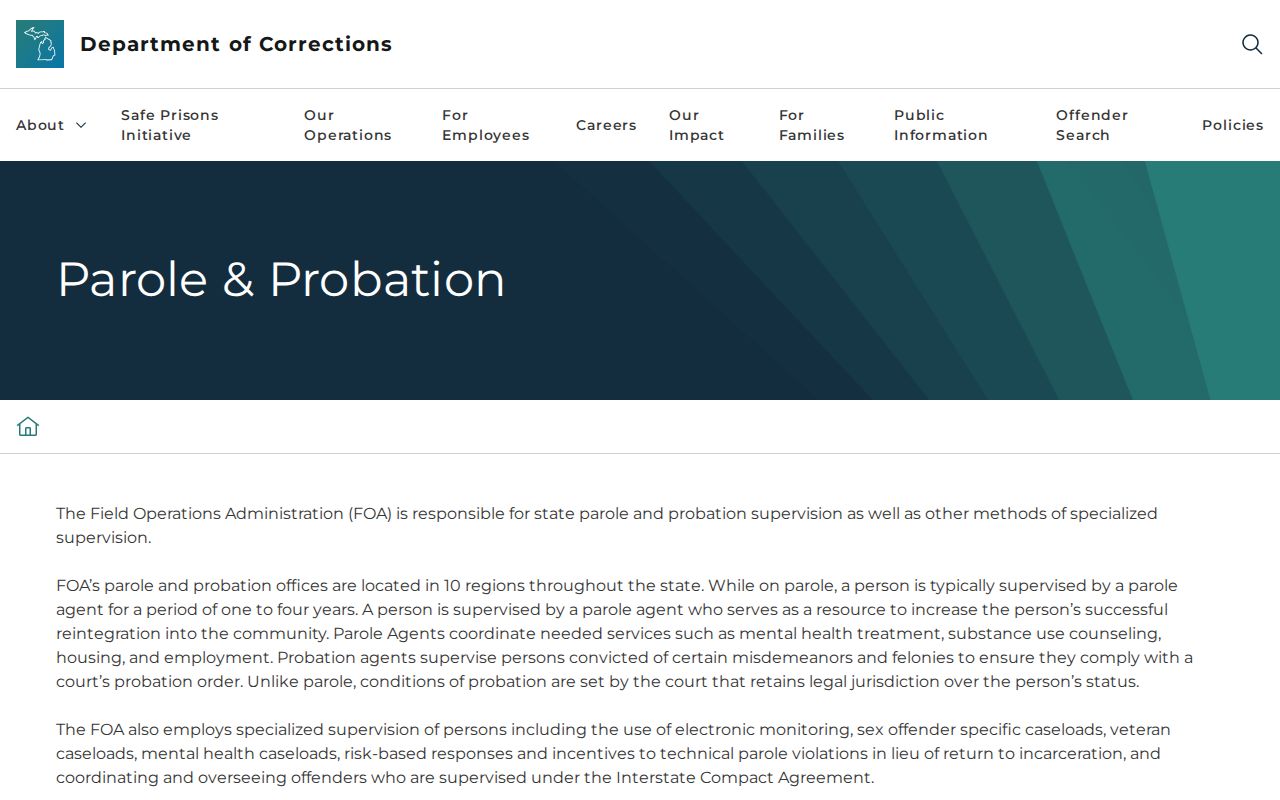
MDOC supervision status and sex-offender registration may overlap for some people, but one system should never be treated as a substitute for the other.
Community Notification and Lawful Use
Luce County residents may use PSOR for personal, family, and community awareness. A listing describes a past conviction and current published registration data. It does not establish present conduct, guarantee that an address remains accurate, or authorize a private investigation. Michigan’s former statewide school-zone scheme should not be described as a current blanket 1,000-foot restriction, and no current Luce-specific residency restriction was verified.
The controlling misuse provision is MCL 28.730. It bars prohibited uses of registry information and preserves criminal penalties for unlawful conduct.
Registry misuse is a crime: MCL 28.730 does not permit harassment, threats, stalking, intimidation, trespass, vigilantism, or other crimes against a registrant or household.
For safety planning, note the profile facts and use an official reporting channel. Do not confront a listed person or circulate claims that go beyond what PSOR publishes.